

🇮🇹 Leggi questo articolo in italiano
A boy, a record player, a 45 found by chance among the records at home. On the sleeve is the name of José de Azpiazu, a Basque guitarist, and inside are Spanish pieces for classical guitar.
The boy listens, and cannot understand. “How can he play like that? It sounds like two guitars!”
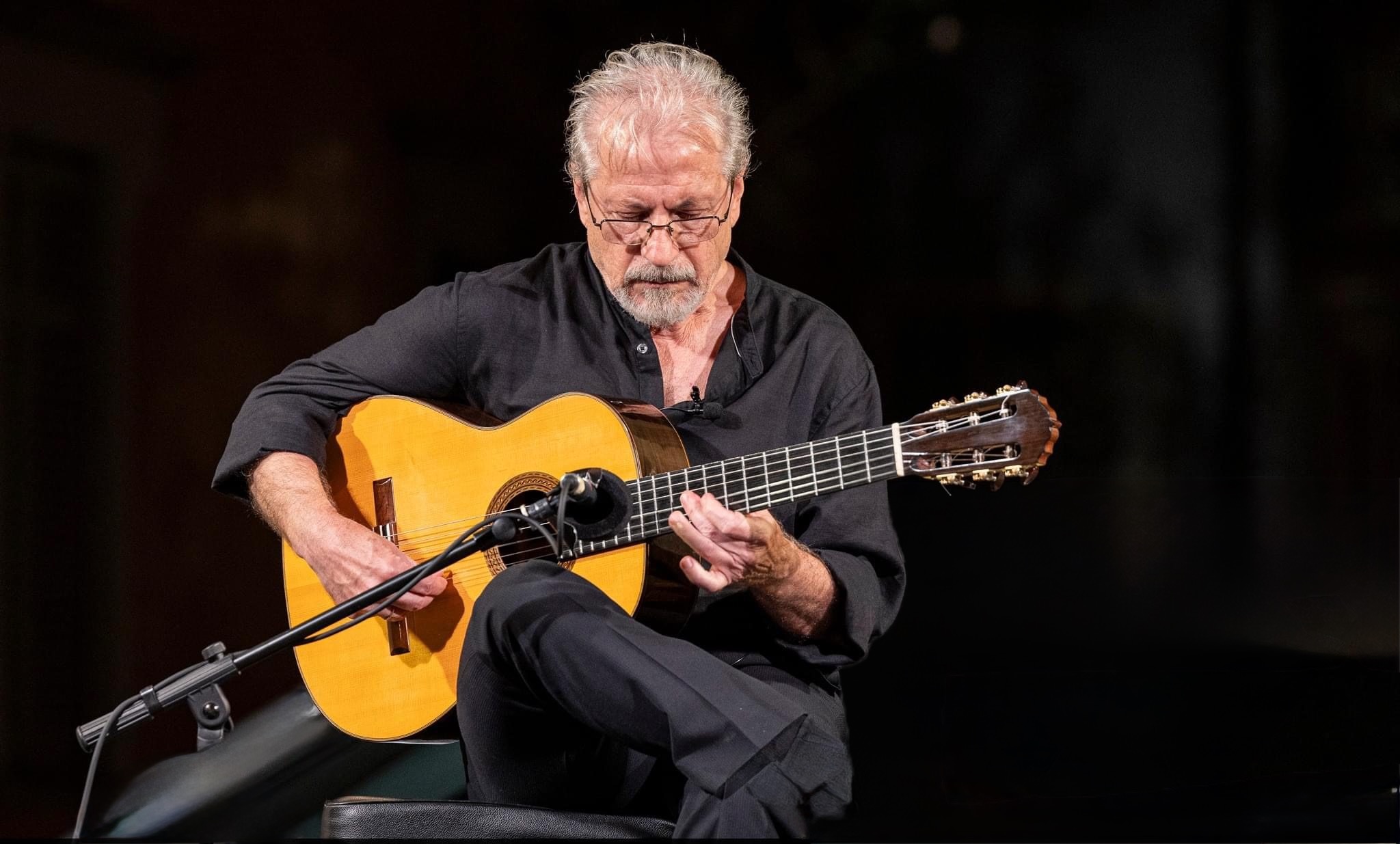
That boy is Renato Pompilio, and that question has never left him. Today he plays jazz on the classical guitar, fingers instead of a pick and nylon instead of steel: a road less traveled in a world dominated by archtops and electric guitars. It is not a style chosen on paper. It is the result of a long journey, in which every stage left something in his right hand: classical guitar, flamenco, Brazil, the harmony of jazz.
Following that journey is the best way to understand how he sounds today.
First the Ear, Then Hard Rock
The story begins at home. Some of his brothers are passionate music lovers and, at some point, a cheap nylon-string guitar turns up. It is there, within reach, and Renato approaches it with no sheet music and no method: he tries to reproduce the sounds he hears or has in his head, discovering the positions a little at a time.
He believes that first approach, free, curious and instinctive, shaped for good the way he lives the instrument.
Then comes the electric guitar. These are the golden years of hard rock and, with his brother and a friend, Renato spends his time chasing the giants: Eric Clapton, Rory Gallagher, Alvin Lee, Johnny Winter, Jimi Hendrix. Amplifiers, distorted solos, volume.
It is right in the middle of all this noise that Azpiazu’s 45 appears. And with it a new world, made of polyphony and a richness of tone the electric guitar could not give him.
So Renato goes back to nylon, this time for real. He studies classical guitar in Alessandria with Guido Margaria, who passes on discipline, care for sound and technique. From those years he keeps what he calls a double soul: the grit and instinct of the self-taught player, and the search for touch, dynamics and harmonic architecture that only deep study leaves inside you.
The Gypsies’ Secret
At some point in his classical studies, the difficult passages arrive. And Renato remembers those Spanish sounds. Gypsy guitarists, he thinks, approach the instrument in a completely different way from those who study in a conservatory. He wants to learn their secret, and he leaves for Spain.
There he studies flamenco with masters such as Manolo Sanlúcar, Rafael Riqueni, Enrique de Melchor and Felipe Maya. And he discovers another way of learning. No academic rigidity: the master sits in front of you, plays a phrase, and you have to catch it on the fly. You watch his hands, absorb the compás, grasp the intention with your eyes and ears.
From Sanlúcar he learns to free his right hand and to give the nylon strings a more percussive, deeper soul.
But his finest memory of those years comes at the dinner table. In the evening, after classes, students and teachers gather in the local taverns. One night Renato and a young Brazilian pick up their guitars and start improvising. The understanding is immediate, and the piece born out of nothing takes a beautiful turn. Sanlúcar listens in silence, then walks over to Renato and tells him: “I wish I had your ability to improvise in any musical genre.”
Coming from one of the greatest flamenco guitarists of the twentieth century, it is a compliment Renato still carries with him.
Voices Like an Orchestra
That ability to move between genres still needed one key: the harmony of jazz. It comes through a pianist Renato is playing with at the time, who introduces him to Filippo Daccò.
Their first meeting lasts for hours. They talk about music in every direction, and Renato tells him about his whole path: the ear, hard rock, classical guitar, flamenco. Daccò greatly appreciates this breadth, and gives him advice that Renato still treasures.
What stays with him most from that teaching is a vision. Not seeing music in watertight compartments, but understanding the deep structure of what you play. And making the voices on the guitar talk to each other as if they were an orchestra.
For someone coming from classical guitar, Renato says, that idea was “pure fuel.” It was another piece of the answer to the question of that boy at the record player. One more piece was missing, and it was on the other side of the ocean.
Recife, and the Secret of Balanço
Brazil arrives through a friendship. In one of the bands he tours Italy with, Renato meets a Brazilian drummer of Italian descent, Mauricio José Lauria Chiappetta. It is Mauricio who passes on to him a deep passion for bossa nova, choro and the whole musical tradition of his country.
When the band breaks up, Mauricio goes back to Brazil. Renato decides he has to visit him. In the early 1980s he leaves for Recife, his friend’s city. It is not a holiday: he wants to immerse himself in Brazilian culture and live that music from the inside.
And there he finds what no record can teach. In Brazil the violão is a social instrument, almost an extension of the body. From records you study the notes; there you learn balanço, that tiny push or lag against the beat that gives bossa nova its groove. And you understand that music is not just a stage performance, but a way of communicating and being together.
Playing that music in front of a Brazilian audience, Renato says, lays you bare. It is a warm but demanding audience: if that natural sway is missing, they notice at once. Passing that test gave him enormous freedom. It swept away the last academic filters and taught him to trust his own instinct.
Baden Powell’s Thumb
Among his Brazilian encounters, there is one that felt to Renato like touching the sky. He meets him after one of his concerts in a club in Rio de Janeiro: it is Baden Powell, one of his absolute idols. In person he finds him charismatic, humble and generous.
Some time later he meets him again in a theater. Baden shows him how he uses the thumb of his right hand, and they play a piece together. On that occasion he makes him understand something Renato has never forgotten: the guitar does not have to be perfect, but true and raw. It has to have saudade inside.
Alongside him, Renato remembers less famous but equally precious musicians, such as João Lyra and Niltinho, teachers at the Recife Conservatory. Each one, he says, left him a small piece of their world.
The Guitarist’s Engine
At this point in the journey, all the pieces are on the table. Each one comes from a different place:
- from classical guitar, touch, care for sound and polyphony: the possibility of making several voices sing at once;
- from flamenco, a free right hand, the percussive thumb, the compás;
- from Brazil, balanço and Baden Powell’s thumb, the “true and raw” guitar;
- from Daccò, harmony and the idea of voices as an orchestra;
- from his self-taught years and from rock, the ear and instinct.
Many guitarists pass through one or two of these worlds. Renato has fused them into a single language, and the point where they meet is always the same: the right hand. That is where he enters jazz.
“The right hand is the guitarist’s real engine,” he says. That is where tone, dynamics and rhythm are born. In traditional jazz the guitar is almost always played with a pick, looking for a linear, fluid, legato sound. Fingers, instead, allow him a polyphony that is unthinkable with a pick: moving the inner voices of a chord, keeping an independent bass line under the melody, improvising with the thumb technique he learned in Spain and Brazil.
The result, he says, is treating the guitar almost like a piano.
Phrases That Turn Vertical
Improvisation changes shape too. The pick, Renato explains, leads to a mostly horizontal, linear way of thinking; the fingers immediately open the door to verticality.
In practice, he can jump from one string to another without the limits of alternate picking. Arpeggios, octave leaps and harmonic substitutions become more fluid. And he can pluck several notes at once, slipping small clusters and chord fragments into the melodic line.
Attack and accents change as well. With thumb, index, middle and ring fingers, accents become polyrhythmic. On repeated notes and fast lines, the alternation of fingers inherited from flamenco and classical guitar gives an articulation almost like a horn, less percussive than a pick but full of nuance. Each finger has its own strength and its own voice. Time, Renato says, is not just marked: it is shaped by touch.
The Hand That Conducts
And when he arranges a standard, the guitar becomes a small orchestra. The right hand is its conductor.
Each finger has a precise role:
- the thumb is the double bass: it gives direction and support with the bass line, often independently;
- the ring finger leads the melody, keeping it in focus in the upper register;
- index and middle fingers fill in the texture with chords and inner voices.
Renato does not like static blocks of chords. He prefers inner voices that move and create tension and release, a legacy of Brazil and classical counterpoint, and perhaps also of Daccò’s lesson about voices as an orchestra. Rhythmically, he looks for a dialogue between the rigor of the bass and the syncopation of the melody: an interlocking in which the guitar breathes and never becomes heavy, even with three layers of sound at once.
Once again, two guitars in one. Or perhaps three.
Wood, Air and Nylon
Playing jazz on a classical guitar, for Renato, is a matter of trade-offs. Nylon gives him a palette of colors that steel does not have: warmth, roundness, intimacy, notes that breathe and a dynamic range that relies on the strength of the fingers alone.
In return, something is lost. The sustain is shorter, fast lines in the upper register take more effort, and there is none of the almost liquid fluency of jazz guitarists on electric. But it is precisely this resistance of the instrument, he says, that pushes him to look for different solutions and to weigh every note.
His guitars are José Ramírez instruments, which he grew up with and has remained faithful to: by now he feels them as an extension of his hands. He uses Savarez strings, which let him move from one genre to another without losing the sweetness of the classical guitar.
Amplification, he admits, is the real headache for anyone playing nylon in jazz. He uses a piezo pickup combined with two internal microphones, and a Bose S1 Pro as his amplifier. The goal is to let the audience hear the true sound of the wood and the air, with the volume needed to converse as an equal with the other musicians.
Fluttering
All these souls meet in Fluttering, the album released by Dodicilune Records. It contains nine original compositions, in which the architecture of classical guitar, the unpredictability of acoustic jazz and the rhythmic warmth of Spain and Brazil live side by side.
The title evokes a beating of wings: a light movement, full of energy. With Renato are Fabio De March on double bass and Nicola Stranieri on drums, seeking a balance between the taste for improvisation and care for the ensemble sound.
The magazine Jazzit named it one of the 100 best European CDs of 2010.
Across the Atlantic
Renato has taken his guitar to Italy, the United States, Brazil, Canada, Spain, France, England, Germany and Switzerland. In the United States he also taught, at Warren Wilson College in North Carolina, where he played with musicians and faculty from the college.
What struck him most was the openness of American audiences and students toward musical crossover. There it does not matter which school you come from: if the music has groove, soul and says something true, the response is immediate. And the students, raised on jazz and blues, were deeply curious about that right hand that had come from Spain and Brazil.
For Those Who Study: Renato’s Advice
For anyone who wants to develop fingerstyle in jazz:
- Start with the thumb. It is your bass player: it has to walk, with a walking bass, or keep time independently of the other fingers.
- Every day, voice leading. On standards, learn to move just one or two notes inside the chord, letting the others ring.
- Avoid tensing your right hand. Always look for softness and relaxation, even when the tempo gets tight.
For a classical guitarist approaching jazz:
- Forget the written page and listen to rhythm with your body.
- Don’t be afraid of mistakes. Classical musicians have extraordinary technique and care for sound, but they are often held back by the fear of a wrong note. “In jazz there are no mistakes: there is only the way you resolve them.”
- Sing before you play. Start by singing the melodies of the standards, then try to reproduce them on the fretboard instinctively, working hard on time and syncopation.
Those who study with us in the Circle of Excellence will recognize a family resemblance in this advice: rhythm that passes through the body, the voice guiding the fingers, inner voices moving one at a time.
Why Listen to Him Today
Because Renato Pompilio shows that the classical guitar in jazz is neither a fallback nor a curiosity, but a language with a strength of its own. Fingers open possibilities a pick does not have: vertical phrases, accents that change from finger to finger, bass, chords and melody in the same hand. Nylon brings warmth, intimacy, the sound of wood and air.
And because he did not learn that language from a method: he built it along the way. In his playing you can hear every stage of the journey, the freedom of the self-taught player, the discipline of classical guitar, the compás of flamenco, the balanço of Brazil, Daccò’s harmony. That is what makes his voice recognizable: not a borrowed technique, but a whole life lived in the right hand.
That boy at the record player wondered how one guitar could sound like two. Today he answers by playing. And when asked to sum up his path, he chooses the words of Samuele Lion:
“What they think of me doesn’t matter, because the road I travel will always be the same. My own.”
Recommended Listening
- Fluttering (Dodicilune Records). Nine original pieces in trio, with Fabio De March and Nicola Stranieri: the meeting point of all his souls.
- Earl Klugh Trio, Volume One. The album Renato himself recommends to anyone who wants to approach his world: the classical guitar turned rhythmic, orchestral and free of stylistic barriers.
- Baden Powell. To understand where the thumb and the saudade Renato talks about come from.
- Manolo Sanlúcar. To hear the flamenco right hand that changed the way he plays.

Scrivi un commento